


What Does "Cage-Free, Grade A, Large, Brown" Mean On an Egg Carton?


Bestsellers for Eggs
On a carton of eggs you might have noticed words like Cage-Free, Grade A, Large, and Brown, one after another. Open Nature's carton in Safeway's egg case carries all four at once. Some of those words are backed by a USDA inspection. Others are just printed on the box, with nobody required to prove them. Here's what each one means.
 Open Nature Eggs Cage Free Large Grade A Brown
What Cage-Free, Free-Range, Pasture-Raised, and Organic Mean
Cage-Free means the hens live uncaged, with unlimited food and water and room to move around their enclosure. That's the whole requirement. It doesn't promise any amount of space per hen, and it doesn't mean the hens ever go outside. A cage-free barn can still be a crowded one.
Free-Range starts from the same rules and adds outdoor access, but USDA never says how much. There's no minimum space and no minimum hours, so a covered porch attached to the barn can satisfy it.
Pasture-Raised is the one term here that USDA doesn't define at all. Any producer can print it on a carton. The words become enforceable only when a certification logo sits next to them, like Certified Humane or American Humane Certified. Certified Humane, for example, requires its pasture-raised farms to give each hen 108 square feet of outdoor space, vegetation to forage in, and at least six hours outside a day, weather permitting. Without a logo like that, pasture-raised is a claim nobody has to verify.
Organic is the one term backed by a federal inspection program. A farm carrying the USDA Organic seal has to give its hens outdoor access year-round, feed them 100% certified organic feed grown without synthetic pesticides or GMOs, and raise them without antibiotics or added hormones. The outdoor space has to be at least 75% soil, with vegetation where the land allows it. Hens can be confined temporarily, but only for a documented health or environmental reason, and an inspector audits all of it. Nobody audits a cage-free barn the same way. One reviewer of the O Organics carton, headed "Good egg," describes "eggs from free range hens, on organic feed" in "colorful cardboard, no plastic."
 O Organics Organic Eggs Large Brown
What Grade AA, A, and B Mean
A grade is a USDA quality check on the shell and the inside of the egg. Grading is voluntary. Producers pay USDA for it, so a grade shield on the carton means an inspector passed that lot. It says nothing about how the hens were raised, and nothing about size. A dozen Grade AA eggs can be small, large, or jumbo.
 Lucerne Farms Eggs Extra Large Grade A
Grade AA is the top mark. Cracked onto a flat surface, the white stands thick and firm around a rounded yolk, and the air pocket inside the shell is barely there. Grade A meets the same clean-shell standard, with a slightly deeper air pocket and a white that spreads a little more. Those two are what you'll see at the store. Grade B, with its stained shells and thinner whites, mostly skips the shelf and goes into the liquid egg used by packaged foods and food service. Shoppers tend to judge that quality by how the eggs show up. One reviewer of the Lucerne large eggs, headed "AA+ for AA Eggs," noted they arrived "so fresh" with "at least 3 weeks left before the code date."
 Lucerne Eggs Large Grade A Family Pack
Egg Sizes, and Why Recipes Call for Large
Egg sizes are set by the weight of a dozen, and USDA defines six of them:
Size | Minimum weight per dozen | Weight per egg |
|---|---|---|
Peewee | 15 oz | about 1.25 oz |
Small | 18 oz | about 1.5 oz |
Medium | 21 oz | about 1.75 oz |
Large | 24 oz | about 2 oz |
Extra Large | 27 oz | about 2.25 oz |
Jumbo | 30 oz | about 2.5 oz |
Recipes assume large eggs. Large has been the American baking standard for decades, and the nutrition facts printed on the carton are based on a large egg too, about 2 ounces of it. The sizes step up by a quarter ounce per egg, so a three-egg cake batter made with jumbos picks up about an extra ounce and a half of liquid, enough to change the texture. In scrambled eggs or an omelet you'd never notice. Bakers notice the size on the shelf. One reviewer of the extra-large Lucerne eggs, "Right size for baking cakes etc," writes that "large sized eggs are not very consistent and sometimes too small for cake."
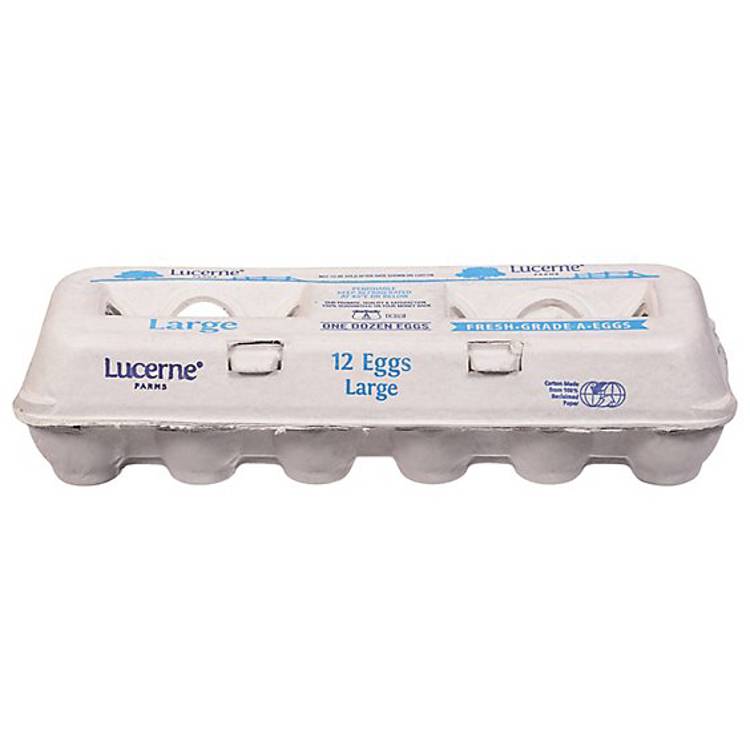 Lucerne Farms Eggs Large
Peewee and small have mostly vanished from retail. Safeway's case runs large, extra-large, and jumbo, stacked side by side.
 Lucerne Farms Eggs Jumbo Grade A
Brown Eggs vs. White Eggs
Shell color is a breed trait. White Leghorns, the standard commercial layer in the U.S., have white feathers and white earlobes and lay white eggs. Rhode Island Reds, Plymouth Rocks, and the other brown-egg breeds have red feathers and red earlobes. The brown is a pigment the hen deposits on the shell just before laying, and under it every egg is white.
Brown eggs often cost a little more because brown-egg breeds are bigger hens that eat more feed. The difference is in the bird, and it ends there. No study has found a nutritional or taste difference between brown and white eggs of the same size, grade, and diet.
 Lucerne Eggs Brown Large A
FAQ
What's the difference between cage-free and free-range eggs?
Cage-free means the hens aren't in cages, but they can be kept entirely indoors. Free-range adds a requirement for access to the outside, though USDA sets no minimum on how much outdoor space or how much time that access has to cover.
Is "pasture-raised" better than "free-range"?
Not by regulation as "Pasture-raised" has no USDA definition, which means that there is no specific standard for using it. "Free-range" is USDA-defined but loosely so again it doesn't mean anything specific. A pasture-raised carton only means something enforceable when it's paired with a third-party certification, like Certified Humane, printed on the label.
What does Grade A mean on a carton of eggs?
Grade A means a USDA inspector checked that lot of eggs and found clean shells, shallow air pockets, and whites and yolks that hold their shape. It's a quality check at the time of grading. It doesn't speak to food safety, size, or how the hens were raised.
Can I substitute small eggs for large eggs in a recipe?
You can in most everyday cooking, like scrambled eggs or an omelet. In baking, it matters more. Three large eggs measure close to four small eggs by volume, and that extra liquid can change the texture of a cake or a batch of cookies once you're using more than two or three eggs.
Are brown eggs healthier than white eggs?
No. Shell color comes from the hen's breed and has no connection to nutrition or taste. Brown eggs sometimes cost more because the breeds that lay them are larger birds that eat more. The egg inside isn't different.
Why does a carton show both a grade and a size?
Grade is a quality check on the shell and interior at the time of grading. Size is a weight-per-dozen classification with nothing to do with grade. A carton can be any combination of the two, like Grade AA Medium or Grade A Jumbo.
Safeway Buying Guide
Vital Farms Eggs Large - 12 Count



Vital Farms Eggs Large - 12 Count is a great product because it is certified humane raised and handled, ethically produced, made with fresh air and sunshine, 100% compostable, has no added sugars, and is produced by a certified B Corporation. In addition, customers can easily visit the farm where their eggs came from with just three steps.
- High quality: Customers appreciate the superior quality of Vital Farms Eggs, noting that they are noticeably fresher and tastier than other brands.
- Ethically sourced: Many reviews highlight the ethically sourced nature of the eggs as a major selling point, with customers appreciating Vital Farms' commitment to animal welfare.
- Large size: The large size of the eggs is frequently mentioned, with customers noting that they are larger than typical store-bought eggs.
- Rich, flavorful yolks: Numerous reviews mention the rich, flavorful yolks of Vital Farms Eggs as a standout feature.
- Consistently fresh: Customers appreciate the consistent freshness of these eggs, often remarking on their long shelf life.
- Healthy option: Many reviews cite the health benefits of these eggs as a major plus, noting their high protein content and organic status.
- Attractive packaging: Several reviews mention the attractive packaging of Vital Farms Eggs, which is not only visually appealing but also sturdy and eco-friendly.
O Organics Organic Eggs Large Brown - 18 Count


O Organics Organic Eggs Large Brown - 18 Count is certified organic, cage free, and meets the Humane Farm Animal Care Program standards. It is also guaranteed 100% quality and satisfaction, or your money back. Nutritious with 6g of protein per serving, these eggs are a great source of calcium and iron.
- Organic: Customers appreciate that these eggs are organic, ensuring they are free from harmful pesticides and chemicals.
- Large Size: The large size of the eggs is a hit with customers, offering more value for their money.
- Brown Shells: The brown shells are not only visually appealing but also indicate a healthier, more natural product.
- Pack of 18: Customers love the convenience of the 18-count pack, allowing for longer use before needing to restock.
- Great Taste: Many reviews mention the delicious taste of these eggs compared to non-organic ones.
- Versatile Use: Users love that these eggs can be used in a variety of dishes, from baking to breakfast.
- Ethically Sourced: Customers appreciate that these eggs are ethically sourced, aligning with their values for animal welfare.
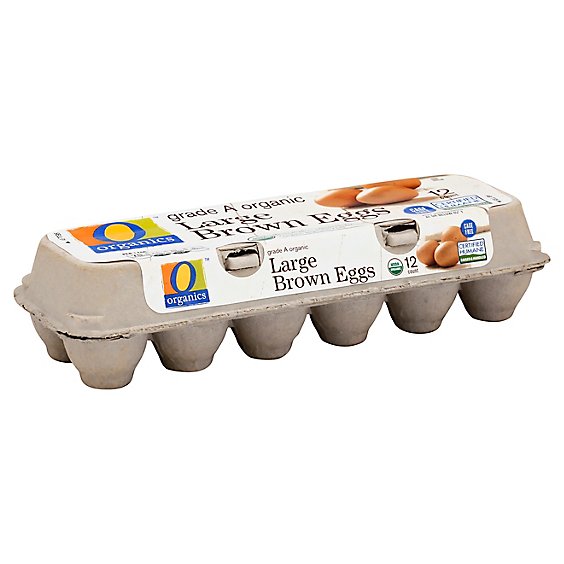
O Organics Organic Eggs Large Brown - 12 Count


O Organics Organic Eggs Large Brown - 12 Count are Grade A organic, cage-free and certified humane raised & handled. They are certified organic by Quality Assurance International, meeting the highest standards for chickens raised without antibiotics and organic vegetarian feed. The eggs have 0g of sugars, only 70 calories and 1.5g of saturated fat per serving. They also meet the Humane Farm Animal Care Program standards to ensure their quality and satisfaction is 100% guaranteed or your money back.
- Organic: Many customers appreciate the organic quality of these eggs, ensuring they are free from pesticides and other harmful chemicals.
- Taste: Reviewers frequently mention the superior taste of these eggs compared to non-organic options.
- Size: The large size of the eggs is often highlighted as a positive feature, providing more value for money.
- Color: The brown color of the eggs is praised by some customers for its aesthetic appeal.
- Freshness: Many reviews highlight the consistently fresh quality of these eggs.
- Humane: Customers appreciate that these eggs are sourced from humanely treated chickens.
- Health Benefits: Some reviewers mention the perceived health benefits of consuming organic products, including these eggs.


