


Cottage Cheese at Safeway


Bestsellers for Cottage Cheese
Cottage cheese spent decades as the sad thing on the side of a diet plate, a scoop next to a canned peach half. Then it came back. The same tub your grandmother bought is now blended into high-protein "ice cream," spread on toast, and stirred into pancake batter, mostly because it turns out to be one of the cheapest, most protein-dense things in the refrigerated aisle.
A half cup has about 12 grams of protein, roughly what you'd get from two eggs, for around 90 to 110 calories. A full cup lands near 24 grams, which puts it shoulder to shoulder with Greek yogurt. One Safeway shopper summed up the whole comeback in three words: "Oldies but goodie."
The one number people skip is sodium, and it's the reason two tubs that look identical aren't. Past that, choosing a tub comes down to a few lines on the label: how much milkfat, how big the curds, how much salt, and whether it's cultured.
The protein, and the number people skip
Protein is why cottage cheese is back, and most of it is casein, the slow-digesting milk protein. There's a lot of it for the calories, and it fills you up more than the calorie count suggests.
Against Greek yogurt, the two are close to even. Low-fat cottage cheese runs about 12 grams of protein per half cup; low-fat Greek yogurt about 10. Both reach roughly 24 grams a cup. The difference that should decide it isn't protein. It's that cottage cheese is salty and Greek yogurt is tangy, and that cottage cheese carries sodium where yogurt carries almost none.
That sodium is worth knowing before you buy. A half-cup serving of regular cottage cheese has somewhere around 300 to 450 milligrams, which is 15 to 20 percent of a day's worth in a single scoop. For most people that's fine. If you're watching blood pressure or salt, it's the number to read first, and the low-sodium tubs are there for exactly that.
 Lucerne Cottage Cheese 4% Small Curd, 24 oz
Lucerne is Safeway's store brand, and it covers the whole aisle: a tub in every milkfat level and both curd sizes. It also has the most reviews of any cottage cheese the store stocks, 4.8 stars across more than 600 of them on the 4% small curd. One gets at the appeal: "It tastes as good if not better than the more well known brands."
Milkfat and curd size: what the label words mean
Two words on the front of the tub confuse people: the milkfat percentage and the curd size. Neither is complicated.
Milkfat is the percentage on the front: nonfat, 1%, 2%, or 4%. It's how much cream gets stirred back in after the cheese is drained. Higher means creamier and a little more rich-tasting; 4% is the original style, nonfat is the leanest. The protein stays about the same across all of them. What changes is fat and calories, so pick by how you want it to taste, not by which one sounds healthiest.
Curd size, small or large, is the size of the lumps, and it comes down to one thing: how finely the curd was cut. Nothing else about the cheese changes. Small curd is finer and smoother, with a slightly tangier edge, and it blends and stirs into things cleanly. Large curd is chunkier and milder, better eaten by the spoonful or with fruit. It's a texture preference, not a quality grade.
So if you're going to blend it or fold it into a recipe, reach for small curd. If you're eating it straight and want something to chew, large curd has the bite.
What else to check: cultures and ingredients
The rest of what separates one tub from another hides in the fine print on the back.
Some cottage cheese is cultured, with live and active cultures listed on the label the way they are on yogurt, and a lot of it isn't. If you want cottage cheese partly for the gut benefit that live cultures may offer, it has to say so. Plain cottage cheese without that line is still a fine protein, just not a cultured food.
The other thing is the ingredient list itself. Many tubs add gums and stabilizers like guar gum or carrageenan for a thicker, more uniform texture. A few keep it to milk, cream, salt, and cultures and nothing else. Neither is wrong, but if a short ingredient list matters to you, it's worth turning the tub around.
 Good Culture Simply Cottage Cheese 2% Classic, 16 oz
Good Culture is the tub for that shopper. It's cultured, made without added gums, and shoppers reach for it on exactly those grounds. One review reads like a label summary: "Cultured. Low salt. Low fat. Extremely versatile." Another: "This cottage cheese has limited ingredients and is delicious." It rates 4.8 stars across more than 80 reviews.
What to actually do with it
Cottage cheese goes almost anywhere, cold or cooked, savory or sweet. A few of Safeway's own recipes show the range.
Blended is where a lot of the trend lives. Run small-curd cottage cheese through a blender and the curds disappear into something smooth you can use as a base. One Good Culture reviewer does exactly this: "Very creamy and not watery. I blend it and use it as a substitute as sour cream in dips."
 Spicy Cottage Cheese "Nacho" Dip with Tortilla Chips
Sweet works the same way. Whipped with a little honey and vanilla, it turns into a high-protein bowl that eats like dessert.
 Whipped Honey-Vanilla Cottage Cheese Bowl with Banana
And it cooks into savory dishes without much fuss, stirred into eggs for a frittata or folded into pancake and muffin batter for protein that doesn't change the flavor much.
 Broccoli, Red Onion & Cottage Cheese Frittata
Who it's for, and the "before bed" idea
Cottage cheese suits anyone trying to get more protein without much effort or money: people on higher-protein diets, anyone on a weight-loss medication like Ozempic or Wegovy who wants a small portion that still carries protein, lifters, and anyone who just wants a filling snack. The reviews bear this out without being asked. One shopper keeps it for "an easy ready to go lunch and lots of recipes on my weight loss journey."
The casein in it is behind the popular before-bed habit. Because casein digests slowly, the idea is that a serving before sleep feeds your muscles through the night. There's a study behind it, and it's worth knowing how small it is: in 2018, Florida State researchers gave 10 active young women 30 grams of protein from cottage cheese before bed and found it worked about as well as a casein supplement for overnight metabolism. Ten people, women only, and it measured metabolic rate rather than muscle directly. So the honest read is that cottage cheese is a reasonable whole-food way to get protein before bed, not a proven muscle-builder. A cup gives you roughly 24 to 28 grams, most of it casein, which is a solid bedtime serving even if it's short of the larger doses used in supplement studies.
A note on sodium and lactose
Sodium is the one real caution. Regular cottage cheese is a meaningful source of it, and if you're managing blood pressure, the standard tubs add up faster than you'd think. The fix is on the shelf: look for "no salt added" or reduced-sodium versions, which drop from the usual 300-plus milligrams per serving down toward 45 to 200. If you can't find one, a quick rinse of the curds in a strainer washes a good deal of the surface salt away.
Lactose is the gentler story. Cottage cheese has less lactose than milk, because most of it drains off with the whey, so people who do poorly with a glass of milk often handle cottage cheese better. It isn't lactose-free unless the label says so, but lactose-free versions exist if you need one.
FAQ
Is cottage cheese good for you?
For most people, yes. It's high in protein (about 24 grams a cup), reasonably low in calories, and a source of calcium. The main thing to watch is sodium, which runs high in regular versions. If that's a concern, low-sodium tubs solve it.
Is cottage cheese or Greek yogurt higher in protein?
They're about even. Low-fat cottage cheese has roughly 12 grams of protein per half cup, low-fat Greek yogurt about 10, and both reach around 24 grams per cup. The real difference is flavor and sodium: cottage cheese is salty, Greek yogurt is tangy and has almost no sodium.
What's the difference between small curd and large curd?
Just the size of the lumps, set by how finely the curd was cut. Small curd is smoother and blends well, which is why it's better for dips, recipes, and the blended trend. Large curd is chunkier and milder, better eaten on its own. Same cheese otherwise.
Which cottage cheese has the most protein?
Protein is fairly steady across milkfat levels, so a nonfat and a 4% tub of the same size have similar protein. What changes between them is fat and calories, not protein. For a big jump in protein you'd look at serving size, not the percentage on the front.
Is cottage cheese good before bed?
It's a reasonable choice. The protein in it is mostly casein, which digests slowly, so it feeds you through the night. A small 2018 study found cottage cheese worked about as well as a casein supplement for overnight metabolism, though it was only 10 people and measured metabolic rate, not muscle. Think of it as an easy whole-food protein at night, not a guaranteed muscle-builder.
Can you eat cottage cheese if you're lactose intolerant?
Often, yes. Cottage cheese has less lactose than milk because most of it drains off with the whey, so many lactose-sensitive people tolerate it. It's not lactose-free unless labeled, and lactose-free versions are available if you need to be sure.
Safeway Buying Guide
Lucerne Cheese Cottage Small Curd 4% Milkfat Min. - 24 Oz



Lucerne Cheese Cottage Small Curd 4% Milkfat Min. is a Grade A cultured cheese with 120 calories and 3g sat fat per 1/2 cup serving.
This product has many positive features, such as being made since 1904, being made with milk from cows not treated with rBST, and having a 100% money back guarantee for quality and satisfaction. Additionally, it has only 120 calories per 1/2 cup serving and 3g of saturated fat, making it an ideal choice if you are looking for a healthy option with minimal fats and calories. It also contains no trans fat or added sugars. Lastly, this product is Kosher certified which gives it an extra level of quality assurance.
- Customers appreciate the high milkfat content of 4%, which gives this Lucerne cottage cheese a rich and creamy texture.
- Many enjoy the small curd size, which provides a distinct texture that is not too chunky or too smooth.
- Consumers love the versatility of this product, with its subtle flavor making it suitable for both sweet and savory dishes.
- The 24 oz size is appreciated by customers as it provides a generous amount of cheese, ideal for families or frequent consumption.
- Users commend the high protein content, making this cottage cheese a nutritious snack or meal addition.
- The cottage cheese's fresh and natural taste has been highly praised by customers, highlighting Lucerne's quality ingredients.
- Customers have noted that it's great value for money given its excellent quality and reasonable price.
Daisy Cheese Cottage Small Curd 4% Milkfat Minimum - 24 Oz


Daisy Cheese Cottage Small Curd 4% Milkfat Minimum - 24 Oz is a Grade A product that contains 13g of protein and 5g of fat per serving. It is rBST free and has no added sugars. It also provides 8% calcium and 17% sodium per serving, as well as 2% potassium. Finally, it is certified Kosher.
- High Milkfat Content: Customers appreciate the 4% milkfat minimum in Daisy Cheese Cottage Small Curd, which gives it a creamier and richer taste.
- Small Curd Size: The small curd size is a hit among users as it offers a unique texture and better mouthfeel.
- Great for Recipes: Many users find this product to be a perfect ingredient for various recipes, enhancing the flavor and texture of dishes.
- Large Quantity: The 24 Oz packaging is appreciated by customers for providing a good amount of product, ensuring they have enough for multiple uses.
- Healthy Option: Customers love that this cottage cheese is a healthy option, providing them with essential nutrients like protein and calcium.
- Quality Brand: Daisy is recognized by consumers as a trusted brand, ensuring them of the product's quality and consistency.
- Versatile Use: Users enjoy the versatility of this product, using it for anything from breakfast to snacks to dinner dishes.
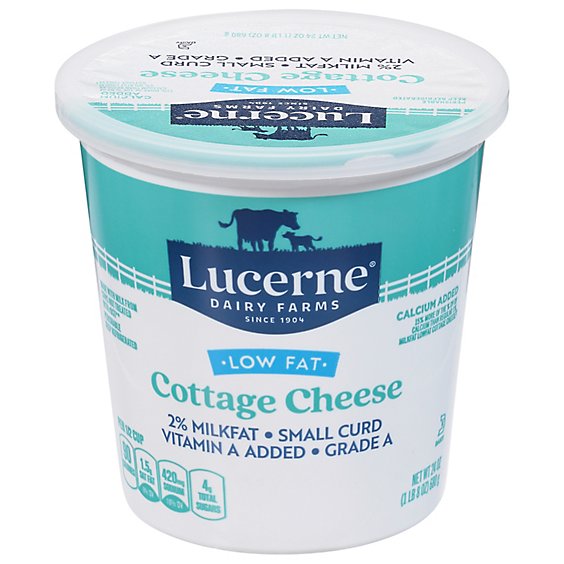
Lucerne Cottage Cheese Small Curd 2% Milkfat Lowfat - 24 Oz


Lucerne Cottage Cheese has 2% milkfat, is low fat, contains 15% more calcium than regular low fat cottage cheese, and is made with milk from cows not treated with rBST.
Lucerne Cottage Cheese Small Curd Lowfat is a great choice for those looking for a healthier alternative to high-fat cheeses. It has only 2% milkfat and is low in calories and saturated fat, making it an ideal option for those watching their calorie intake. Additionally, this product contains 15% more calcium than regular 1% milkfat cottage cheese, providing essential vitamins and minerals to help maintain strong bones and teeth. The milk used to make this product also comes from cows that have not been treated with rBST, ensuring quality control standards are met. Finally, the product is Kosher certified for those who follow a strict dietary code.
- Low in fat, with just 2% milkfat, making it ideal for those on a diet or looking to maintain a healthy lifestyle.
- Small curd texture is smooth and enjoyable, as noted by several customers.
- Comes in a generous 24 oz size, providing great value for the cost.
- Produced by Lucerne, a trusted and reliable brand in the dairy industry.
- Has a fresh and natural taste that many customers appreciate.
- Versatile - can be used in various dishes or enjoyed on its own.
- Many customers note that it's rich in protein, making it great for muscle building and recovery after workouts.


