


Granola, Cereal, Breakfast and Protein Bars Explained
Granola bar, cereal bar, breakfast biscuit, protein bar, chewy and crunchy. All are five products on the same shelf, with slight differences. You find them side by side in the morning aisle, packaged in similar boxes with similar promises of quick energy. At a glance, they look almost interchangeable.
FDA standards do not define granola bars, cereal bars or breakfast biscuits. There is no federal standard of identity setting down a required recipe or mandating what ingredients must be present to earn those names. Unlike staple foods with strict legal definitions, manufacturers have wide leeway in how they label a grain snack. A brand can call a baked oat square a breakfast bar or a granola bar without violating any federal naming standard.
Because the title on the front cannot tell you how the food is made, your best routine starts on the back panel. You should read the first three ingredients and the serving line to see what the package contains and how much the nutrition numbers cover.
Under FDA rules in 21 CFR 101.4, ingredients are listed in descending order of predominance by weight. The heaviest ingredient appears first, followed by the second and third.
That order shows how the recipe is built. Before mixing, every ingredient is weighed. The heaviest ingredient takes the first spot, the second follows, and the third comes next. If whole rolled oats or nuts lead the list, whole food forms the foundation. If corn syrup, invert sugar, or fruit puree concentrate fills those top spots, sweeteners make up a major share of the bar's weight. Looking at those top three items tells you what you are actually holding before you look at marketing claims.
Checking the serving line alongside those ingredients keeps the numbers in perspective. A box might show appealing numbers for calories or sugar, but those figures only apply to the specific portion printed at the top of the panel.
Protein is different. Once a package makes a protein claim, federal rules require a protein percent Daily Value on the Nutrition Facts panel. For standard snack bars, manufacturers can print the gram weight and leave the percent column blank. The moment a box highlights protein on the front, federal rules demand proof on the back panel so shoppers can see how much usable protein they are actually getting.
Granola Bars Can Be Chewy or Crunchy
Granola bars usually start with rolled oats. Rolled oats are oat groats that have been steamed and flattened, with the same base also being used in oatmeal or loose granola, as the guide to steel-cut, rolled and instant oats explains. Steaming softens the oat groat before heavy rollers flatten it into a flake, allowing it to absorb liquids and hold together in a bar.
The Whole Grains Council and the USDA describe a whole grain as one that retains the bran, germ and endosperm. Those three parts make up the complete seed: the fiber-rich bran, the nutrient germ, and the starchy endosperm. When a grain retains all three, nothing has been milled away.
A "made with whole grain" statement does not say how much whole grain is in the bar, so the ingredient list is the place to check whether whole oats appear first by weight. A manufacturer can place "made with whole grain" on the front of a carton even if whole grains make up only a small fraction of the recipe. Checking the ingredient list shows whether whole oats lead the recipe or sit behind refined flours and syrups.
Texture divides the shelf into chewy and crunchy styles. A chewy bar needs a binder. Without something sticky and pliable to hold the grains together, the bar would crumble into loose granola in the wrapper.
Signature SELECT, Safeway's own brand, lists granola first in its Chewy Chocolate Chip bar, followed by corn syrup, corn syrup solids, vegetable glycerin and invert syrup. Granola leads the recipe by weight, and a blend of syrups and humectants locks it into a soft shape.
An ingredient manufacturer, Ingredion, says chewy bars are dried and that their softness often depends on how much moisture they retain. Rather than baking the dough until it crisps, makers dry it gently to preserve moisture inside.
Invert syrup is made of glucose and fructose split apart from sucrose, and vegetable glycerin is a humectant, meaning it holds water in the bar. Invert syrup resists crystallization, keeping the texture bendable. Vegetable glycerin attracts water molecules and holds them tight, stopping the bar from drying out in your pantry.
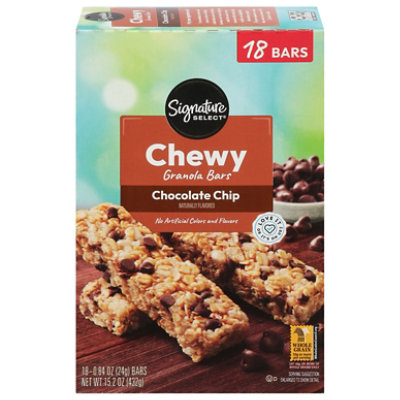
Ingredients Granola (Whole Grain Oats, Sugar, High Oleic Canola Oil, Honey, Salt, Natural Flavors, Mixed Tocopherols [Antioxidant]), Corn Syrup, Semi Sweet Chocolate Drops (Sugar, Chocolate Liquor, Cocoa Butter, Soy Lecithin, Salt, Vanilla Extract), Whole Grain Brown Rice Flour, Corn Syrup Solids, Sugar, Vegetable Glycerin, Invert Syrup, Contains Less than 2% of Coconut, Palm Oil, Calcium Carbonate, Salt, Cocoa, Mixed Tocopherols (Added for Freshness), Natural Flavors.

Crunchy bars rely on a different process. On the other hand, Ingredion says crunchy bars need a baking step. The heat of the oven sets the grains and drives moisture out of the dough, giving the bar its firm snap.
The Signature SELECT Crunchy Oats & Honey list begins with whole grain rolled oats, sugar and high oleic canola oil. It also includes baking soda, while its only syrup appears among ingredients that make up less than 2%. Rolled oats take the top spot, followed by sugar and oil. Baking soda acts as a leavener to puff the dough slightly before baking crisps it. Because syrup appears only below 2%, the bar holds together through baked sugar and oil rather than sticky syrups.
The serving of the crunchy bars is two, differing from the single serving of the chewy bars. A single chewy bar is a complete serving, but the crunchy version packages two bars in a single wrapper. Baking drives off moisture, which is part of why these bars are drier than the chewy ones. That lack of water produces a hard, snap-in-half texture.

Ingredients Whole Grain Rolled Oats, Sugar, High Oleic Canola Oil, Whole Grain Brown Rice Flour, Contains Less than 2% of Honey, Salt, Brown Sugar Syrup, Baking Soda, Soy Lecithin, Natural Flavors.

Cereal Bars and Breakfast Biscuits Use Different Builds
A cereal bar is usually a soft grain crust around a fruit filling. Instead of mixing oats throughout the entire bar, the manufacturer creates an outer shell of dough wrapped around a sweet jelly core.
The Signature SELECT Fruit & Grain Strawberry bar lists its strawberry filling first, with invert sugar, corn syrup, strawberry puree concentrate, sugar and glycerin. The crust is oats and wheat flour, and the same syrups and glycerin that bind a chewy granola bar are evident in both the filling and the crust. Listing strawberry filling first means the sweet center outweighs the grain crust. Invert sugar, corn syrup, and sugar sweeten the concentrate, while glycerin keeps the fruit gel soft so it does not dry out.
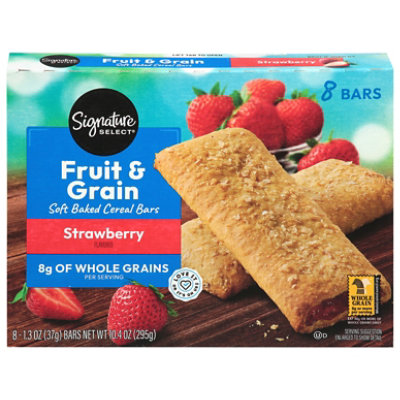
Ingredients Strawberry Filling (Invert Sugar, Corn Syrup, Strawberry Puree Concentrate, Sugar, Glycerin, Modified Corn Starch, Sodium Alginate, Citric Acid, Monocalcium Phosphate, Dicalcium Phosphate, Methylcellulose, Malic Acid, Fruit and Vegetable Juice for Color [Radish, Apple and Blackcurrant Concentrates], Natural Flavors), Whole Grain Rolled Oats, Whole Grain Wheat Flour, Enriched Wheat Flour (Bleached Wheat Flour, Malted Barley Flour, Niacin, Reduced Iron, Thiamin Mononitrate, Riboflavin, Folic Acid), Vegetable Oil Blend (Canola, Palm, Palm Kernel), Invert Sugar, Sugar, Glycerin, Contains Less than 2% of: Whey, Calcium Carbonate, Corn Syrup Solids, Honey, Wheat Bran, Salt, Potassium Bicarbonate (Leavening), Vital Wheat Gluten, Corn Starch, Xanthan Gum, Vitamin A Palmitate, Reduced Iron, Thiamin Hydrochloride (Vitamin B1), Riboflavin (Vitamin B2), Niacin (Niacinamide), Pyridoxine Hydrochloride (Vitamin B6), Folic Acid, Cyanocobalamin (Vitamin B12), Zinc Oxide, Dicalcium Phosphate, Natural Flavors.

A breakfast biscuit is a baked biscuit sold in a pack. These are thin, crisp wafers designed to be eaten slowly, often paired with a morning drink.
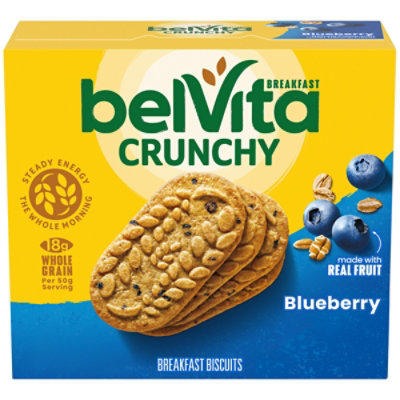
The belVita Blueberry ingredient list starts with a whole grain blend of rolled oats and rye flakes, followed by enriched wheat flour and sugar. It also contains canola oil, wheat flour, dried blueberries, malt syrup and baking soda. The recipe blends rolled oats and rye flakes with standard wheat flour, canola oil, and leavening. Malt syrup and sugar provide sweetness and promote browning, while dried blueberries add fruit pieces throughout the biscuit.
One Nutrition Facts serving is one pack, which contains four biscuits. That four-biscuit pack changes how you eat it; you can eat all four at once or spread them across a morning.
Under the FDA standard for enriched flour (21 CFR 137.165), enriched flour contains added thiamin, riboflavin, niacin, folic acid and iron. When whole grain flour is milled into white flour, the nutrient-dense bran and germ are removed. Federal standards require manufacturers using the term "enriched flour" to restore specific amounts of those four essential B vitamins alongside iron. In the belVita biscuit, enriched wheat flour sits right behind the whole grain oat and rye blend.
Protein Claims Have Federal Rules
A protein bar is identified by its claim and the protein percentage that must support it. While front-of-package marketing can be loud, the words used are governed by strict federal standards. The FDA states the terms "good source," "contains" or "provides" apply when a food has "10 to 19 percent" of the Daily Reference Value per customary amount. For "high," "rich in" or "excellent source of" descriptions, it requires "20 percent or more".
Under FDA regulation 21 CFR 101.9(c)(7)(iii), the Daily Reference Value (DRV) for protein is 50 grams for adults and children 4 years of age and older, based on a 2,000-calorie reference diet. At that 50 g reference, 10 to 19 percent works out to 5 to 9.5 grams of protein and 20 percent to 10 grams, counted after the quality correction described next. To claim "good source" or "contains protein," a bar must deliver at least 5 grams of usable protein. To claim "high protein" or "excellent source of protein," it must deliver at least 10 grams.
The percentage belongs on the Nutrition Facts panel whenever the package makes a protein claim as the FDA outlines that "such a statement shall be given if a protein claim is made for the product." A bar that prints grams but no percent has made no protein claim on the front. A standard granola bar might list 2 or 3 grams of protein on the side panel, but the percent Daily Value column will sit empty. Once a brand prints a protein claim on the front, that percentage must appear.
The protein percent Daily Value is calculated from a corrected protein amount that uses the Protein Digestibility-Corrected Amino Acid Score (PDCAAS), capped at 1.00, so proteins that score lower than 1.00 produce a lower percentage than the gram figure alone would suggest. PDCAAS measures protein quality based on human amino acid requirements and digestive absorption. Proteins scoring below 1.00 have their gram count adjusted downward before dividing by 50 grams.
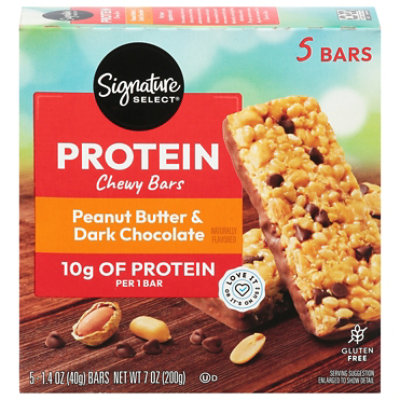
The Signature SELECT bar adds protein ingredients. Its first ingredients are roasted peanuts, soy protein isolate and chicory root extract, with whey protein concentrate appearing later. One bar lists 10g protein and an 18% Daily Value. Ten grams is 20% of 50 grams, so the lower 18% on the panel is consistent with the PDCAAS correction. The peanut blend pulls the calculated score below 1.00.
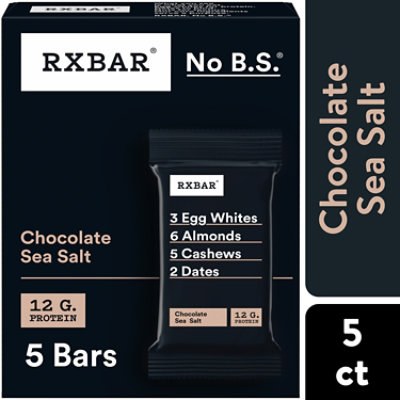
RXBAR uses a shorter ingredient list of dates, egg whites, cashews and almonds. Its description states dates bind the bar and egg whites provide protein. The panel lists 12g protein and a 20% Daily Value. Egg whites provide complete protein that digests easily, helping the bar reach that 20% mark.
Clif Builders is another bar on the protein shelf. Its name carries a gram figure, so apply the same test: look for the percent Daily Value on the panel before you compare it with the two above.

The panel also shows the difference between total and added sugars, with RXBAR showing 14g total sugars and 0g added sugars. Dates are listed as the first ingredient, meaning this is where the sugars are from. Total sugars include sugars already present in an ingredient, while the added-sugars line records sugars added during production. Dates naturally contain simple sugars like glucose and fructose, which are tallied under total sugars. Because no cane sugar or syrups are added during manufacturing, the added sugars line stays at zero.
The FDA sets the Daily Value for added sugars at 50 grams per day, which matches the Dietary Guidelines for Americans advice that added sugars stay below 10% of calories in a 2,000-calorie diet.
FDA rules under 21 CFR 101.60 govern sugar claims. A "no added sugar" claim requires that no sugar or sugar-containing ingredient was added during manufacturing. The product must also bear a statement that it is not "low calorie" or "calorie reduced" unless it meets those definitions. That disclaimer keeps shoppers from confusing no added sugar with low calories. A "reduced sugar" claim requires at least 25 percent less sugar per reference amount customarily consumed than an appropriate reference food.
Dietary fiber is also prominent on protein bar panels, with an FDA Daily Value of 28 grams per day based on a 2,000-calorie diet (21 CFR 101.9). RXBAR lists 5 grams of fiber (18% DV) and the Signature SELECT protein bar lists 4 grams (14% DV). The Signature SELECT bar contains chicory root extract, a source of inulin, and the FDA includes inulin and inulin-type fructans among the isolated fibers that count as dietary fiber on the label.
Compare the Serving Before the Numbers
The six panels cover one bar, two bars or one pack, so the numbers apply to different amounts. The crunchy granola entry covers two bars. The biscuit entry covers a pack of four.
Read the serving line before comparing calories, fiber, sugars or protein. If you look only at the calorie count, a 190-calorie crunchy bar might look twice as heavy as a 90-calorie chewy bar. But the chewy bar panel reflects a single bar, while the crunchy bar panel reflects two.
Under FDA regulations (21 CFR 101.9 and 21 CFR 101.12), serving sizes are based on Reference Amounts Customarily Consumed (RACC), which is 40 grams for grain-based bars such as breakfast, granola and rice cereal bars. Because the crunchy bars count two to a serving, a 12-count box holds 6 servings. Two 20-gram bars are paired to reach the 40-gram reference amount.
A package holding 200 to 300 percent of the reference amount must add a second column showing nutrition for the whole package. That dual-column format displays numbers for one serving alongside totals for the whole container.
Product | Serving | Cal | Fiber | Total sugars | Added sugars | Protein | Protein %DV printed |
|---|---|---|---|---|---|---|---|
Signature SELECT Granola Bars Chewy Chocolate Chip | 1 bar | 90 | 1g | 7g | 7g | 1g | none |
Signature SELECT Granola Bars Crunchy Oats & Honey | 2 bars | 190 | 2g | 11g | 11g | 3g | none |
Signature SELECT Cereal Bars Fruit & Grain Strawberry | 1 bar | 130 | 1g | 12g | 11g | 1g | none |
belVita Blueberry Breakfast Biscuits | 1 pack | 230 | 2g | 12g | 11g | 3g | none |
Signature SELECT Chewy Bars Protein Peanut Butter Dark Chocolate | 1 bar | 190 | 4g | 7g | 5g | 10g | 18% |
RXBAR Protein Bars Chocolate Sea Salt | 1 bar | 200 | 5g | 14g | 0g | 12g | 20% |
Added sugars show the effect of the serving most clearly. At a 50 gram Daily Value, the 7g added sugars in a chewy granola bar is 14% DV, while the 11g in the crunchy granola serving, the strawberry bar and the belVita pack is 22% DV, which is above the 20% that FDA guidance treats as high. Under FDA guidance, 5% DV or less is low, and 20% DV or more is high. RXBAR's 0g added sugars is 0% DV, and its 14g of total sugars is not counted in that figure.
Common Questions About Breakfast Bars
What is the difference between a granola bar and a protein bar?
Granola bars commonly combine oats with a binder, although FDA rules do not define the name. Protein bars advertise protein, so their Nutrition Facts panels must show protein as a percentage of Daily Value. Their ingredients can still differ, with one example containing soy and whey protein ingredients, while another begins with dates and egg whites. In the table below, the granola and cereal bars list 1 to 3 grams of protein, while the two protein bars list 10 and 12 grams.
What makes a granola bar chewy?
Chewy bars use a binder, and the examples here list syrups and glycerin. Ingredion says they are dried and become softer when they retain more moisture. Invert syrup and vegetable glycerin trap water in the bar and prevent sugar crystallization, keeping the oats pliable rather than brittle.
Are cereal bars the same as granola bars?
The names have no FDA standard of identity. In the examples shown, the cereal bar has a fruit filling and grain crust, while the granola bars use a base of oats. The cereal bar wraps an outer grain crust around a jam-like fruit filling, whereas granola bars mix oats and binders throughout the entire bar.
What does high protein mean on a label?
On a label, "high protein" means one serving supplies at least a fifth of the day's protein reference amount. The regulatory cutoff is 20%, and a protein claim requires the Nutrition Facts panel to show protein as a percent Daily Value. Under FDA rules (21 CFR 101.9), the protein Daily Reference Value is 50 grams. On a 50 gram reference, that is 10 grams of protein after the PDCAAS quality correction.
Why does a protein bar list 0g added sugars but 14g total sugars?
The RXBAR panel shows those figures. Dates are its first ingredient, so the total sugars include sugars in the dates while 0g added sugars means none were added during production. Total sugars count all sugars in the food, including natural fruit sugars. The added sugars line tracks only sweeteners added during production.
How many granola bars are a serving?
Read the serving line. In the examples shown, chewy bars are one serving, and crunchy bars are two. FDA serving sizes for grain-based bars start from a 40 g Reference Amount Customarily Consumed (RACC). Because individual crunchy bars weigh about 20 grams, two bars are paired to reach that reference amount.
What is the Daily Value for added sugars on the Nutrition Facts label?
The FDA Daily Value for added sugars is 50 grams per day based on a 2,000-calorie diet, matching Dietary Guidelines for Americans advice to keep added sugars below 10% of calories. The % Daily Value shows what portion of that limit one serving delivers: FDA guidance treats 5% DV or less as low and 20% DV or more as high.
What do "whole grain" and "made with whole grain" mean on a package?
The USDA and the Whole Grains Council describe a whole grain as one that keeps the bran, germ and endosperm. A "made with whole grain" statement does not say how much whole grain is in the bar. The ingredient list shows whether whole oats appear first by weight. Checking that list confirms whether whole grain is the main ingredient.