


Tart Cherry Juice: Common Questions About Inflammation, Gout, and Exercise Recovery
Most people first hear about tart cherry juice for sleep. But the same compounds that may help with sleep also have anti-inflammatory properties (meaning they may help reduce swelling and pain). Research has looked at tart cherry juice for gout, muscle soreness after exercise, and general inflammation.
Is tart cherry juice actually anti-inflammatory?
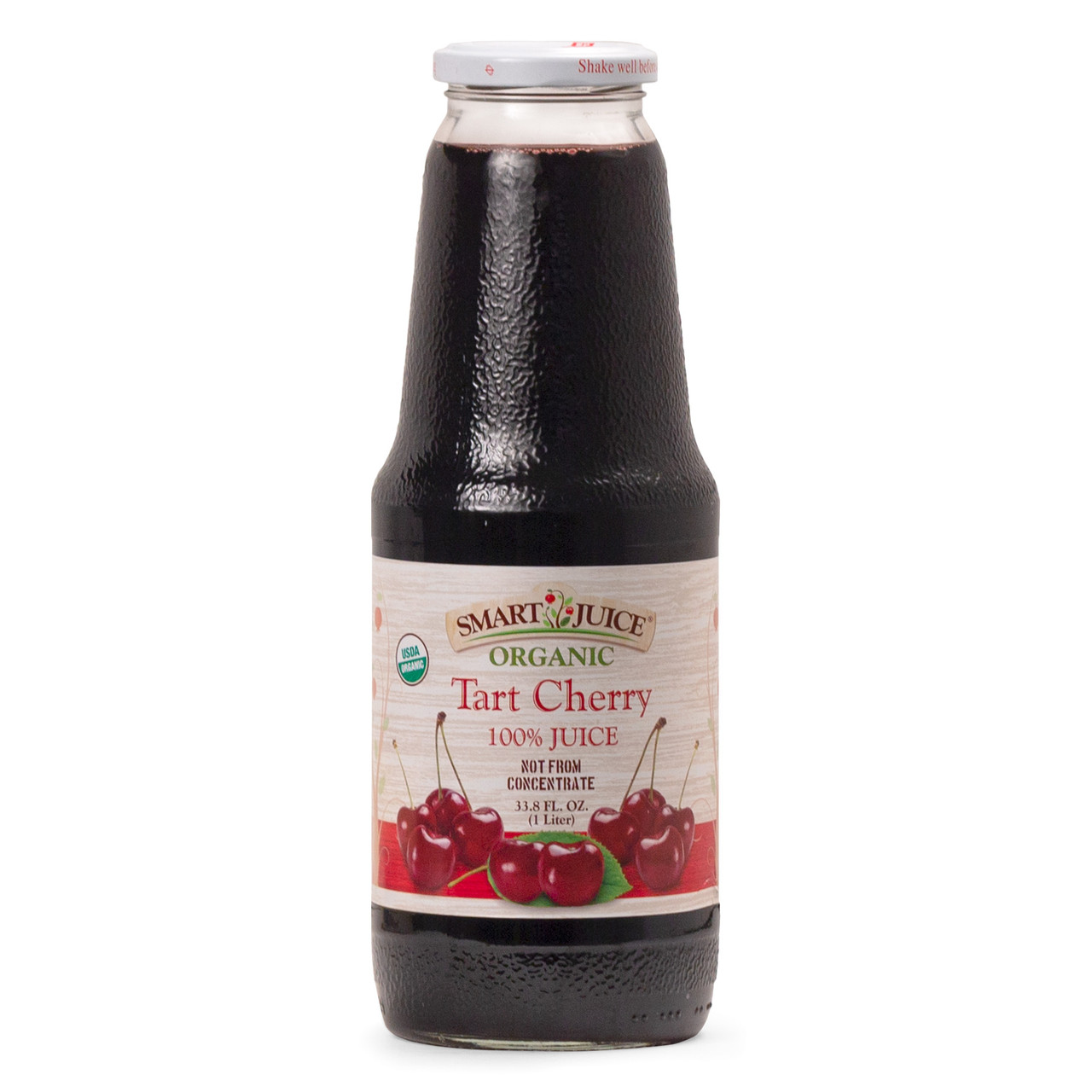
Smart Juice Organic Tart Cherry - 33.8 Fl. Oz.
Tart cherries get their deep red color from compounds called anthocyanins (natural plant pigments). These pigments block some of the same enzymes that over-the-counter pain relievers like ibuprofen target. A 2001 lab study found that cherry anthocyanins blocked pain and swelling signals at levels comparable to ibuprofen and naproxen.
That said, results in a lab don't always match what happens in the body. But when researchers looked at 16 human studies, 11 of them found measurable drops in inflammation markers (substances in the blood that indicate inflammation) after people drank tart cherry juice. The evidence suggests real anti-inflammatory activity, though how much it helps varies from person to person.
What's the difference between tart cherry juice and regular cherry juice?
The research is on tart cherries, usually the Montmorency variety. These are sour cherries, too tart to eat by the handful, grown mainly for juice and cooking. They contain significantly more anthocyanins (the anti-inflammatory pigments) than sweet cherries like Bing or Rainier, anywhere from 27% to 200% more depending on the study.
When you're shopping, look for "tart cherry" or "Montmorency cherry" on the label. A bottle that just says "cherry juice" without specifying is probably made from sweet cherries, which have less research behind them and lower levels of the compounds that matter.
Does tart cherry juice help with gout?
It might, but the research isn't settled yet. The largest study (633 people with gout, published in Arthritis & Rheumatism in 2012) found that people who ate cherries had a 35% lower chance of a gout flare compared to times when they didn't eat cherries. People who combined cherries with their prescribed gout medication saw a 75% lower chance.
Those numbers are encouraging, but that study was observational (it tracked what people were already doing, rather than assigning a specific treatment). A more controlled 2020 study gave tart cherry concentrate to 50 gout patients at different doses for 28 days and found no significant effect on uric acid levels or flares. That study was small and short, but it's the most carefully designed trial on this question so far. A larger 12-month trial out of the UK was designed to give a clearer answer, but results haven't been published yet.
Tart cherry juice is a food, not a medication. If you have gout, it's worth discussing with your doctor as something you might add alongside your current treatment, not as a replacement.
What is gout?
Gout is a type of arthritis that happens when there's too much uric acid (a waste product your body makes naturally) in your blood. Normally, your kidneys filter uric acid out. When levels get too high, it forms tiny needle-shaped crystals that collect in joints, most often the base of the big toe.
A gout flare happens when your immune system spots those crystals and attacks them. The result is sudden, intense pain, swelling, and redness that usually peaks within 12 to 24 hours and can last a week or more. About 9.2 million Americans have gout. It's roughly twice as common in men as in women. Common triggers include red meat, shellfish, beer, and sugary drinks with high-fructose corn syrup.
Why do people with gout drink tart cherry juice?
Researchers think there are two possible ways. First, the anthocyanins may slightly slow down the enzyme that produces uric acid. This is the same enzyme that gout medications like allopurinol target, though cherry's effect is much weaker. Second, the anti-inflammatory compounds may calm down the body's reaction when it encounters uric acid crystals in the joints, reducing the pain and swelling of a flare.
The 2020 study that found no drop in uric acid levels led the researchers to an interesting conclusion: if tart cherry does help with gout, it probably works by reducing inflammation rather than by lowering uric acid itself. In plain terms, it may not stop crystals from forming, but it may reduce how much your body overreacts to them. This hasn't been confirmed in a large study yet.
Will tart cherry juice help my muscles recover after a workout?

The research here is more consistent than the gout research. A 2021 review that combined results from 14 studies (about 294 people total) found moderate benefits for strength and power recovery after exercise. A 2025 review of 10 studies found that people who drank tart cherry juice recovered about 9% more strength compared to those who didn't, and had lower levels of certain inflammation markers in their blood.
The catch: those same reviews found that tart cherry juice didn't make a big difference in how sore people actually felt. The muscles recovered their function faster (you could lift or push more sooner), but the subjective feeling of soreness wasn't dramatically different. So if you're expecting to wake up pain-free the morning after a hard workout, that's not what the research shows. It's more about getting your strength back sooner.
Do I drink it before or after working out?

Before. This is the part most people get backwards. A 2022 research review coined the term "precovery" to describe the finding that tart cherry juice needs to be in your system for several days before hard exercise to work. Studies where people started drinking it on the day of exercise or after showed little to no benefit.
The pattern in the research: start 4 to 5 days before a hard workout or race, continue on the day of, and keep going for 2 to 3 days after. It takes time for the anti-inflammatory compounds to build up in your body. Studies with fewer than 3 days of pre-loading consistently showed no benefit. If you're drinking it for the first time the morning of a race, you've already missed the window.
Has tart cherry juice actually been tested on athletes?
Three stand out. A 2010 study of 20 London Marathon runners found faster strength recovery and significantly lower inflammation when runners drank tart cherry juice for 5 days before and 2 days after the race. A second 2010 study of 54 relay runners (the largest group tested) found 12% less muscle pain in the cherry juice group.
The most surprising result came from a 2015 study of 20 marathon runners. Researchers tracked cold and flu symptoms after the race. None of the runners in the cherry juice group got sick in the 48 hours after the marathon, compared to half the placebo group. Hard exercise temporarily weakens the immune system, and the anti-inflammatory compounds may help counteract that. This was a small study and would need to be repeated, but it's an interesting finding.
Should I drink tart cherry juice every day if I work out regularly?

This is a question the research hasn't fully answered. The soreness and inflammation you feel after exercise isn't just damage. It's also your body's signal to rebuild stronger. There's a concern, similar to the debate about popping ibuprofen after every workout, that constantly blocking that signal could slow your fitness gains over time.
No study has directly tested whether daily tart cherry juice gets in the way of long-term training progress. But the National Strength and Conditioning Association (NSCA, a major professional organization for trainers and coaches) suggests using it around competitions, races, or especially hard training weeks rather than every single day. That feels like reasonable advice. Save it for when you need to recover quickly, not as a daily habit that might dull the signals your body uses to get stronger.
How much tart cherry juice should I drink?
Most studies used one of two approaches:
Juice: 8 to 12 ounces per serving, twice a day (morning and evening). That adds up to about 280 calories and 60 to 66 grams of natural sugar per day. It's a lot of sugar.
Concentrate: 1 ounce (about 2 tablespoons) per serving mixed into water, twice a day. About 80 to 100 calories per serving. Lower sugar, lower cost per serving, and you control how diluted it is.
Concentrate is the more practical choice for most people. A small bottle lasts a while at 1-ounce servings, and you avoid the heavy sugar load of full-strength juice.
Should I buy juice, concentrate, or capsules?
Juice or concentrate. Every positive study on exercise recovery used one of these two forms. Results with capsules and powders have been inconsistent. One sleep study found no benefit at all from capsules, and the researchers suggested that the beneficial compounds may not survive being processed into powder.
Part of the reason may be that tart cherry juice contains multiple compounds (anthocyanins, melatonin, kaempferol, quercetin, and others) that appear to work better together than alone. A 2010 study found that specific pairs of these compounds boosted each other's effects. That kind of teamwork is harder to replicate in a capsule that isolates one or two ingredients.
Look for Montmorency tart cherry juice or concentrate. R.W. Knudsen is a commonly available brand. Check that it says 100% juice with no added sugar. Avoid anything sweetened with high-fructose corn syrup, especially if gout is a concern, since fructose can actually raise uric acid levels.
Are there any side effects from drinking tart cherry juice?
The most common issue is digestive. Tart cherries contain sorbitol, a natural sugar alcohol (the same stuff that makes prune juice work as a laxative). Some people get bloating, gas, or loose stools, especially when they first start or drink a lot. Starting with one serving a day and working up to two can help.
The bigger practical concern is sugar and calories. Two glasses of juice per day adds about 280 calories and over 60 grams of sugar, all from the fruit. If you're watching your weight or blood sugar, concentrate mixed into water is the better option. People on blood thinners, blood pressure medication, antidepressants, or sleep medications should mention it to their doctor. No serious interactions have shown up in studies, but the active compounds could theoretically interact with these medications.
Do I need to talk to my doctor before trying tart cherry juice?

If you're generally healthy and curious whether it helps with post-workout soreness, tart cherry juice is a grocery item. Use the same judgment you'd use with any other juice.
If you have gout, diabetes, kidney issues, or take medication regularly, a quick conversation with your doctor is a good idea. For gout in particular, the strongest finding in the research (the 75% lower flare risk) came from people who added cherries to their prescribed medication, not from people who used cherries instead of their medication. Tart cherry juice may be a useful addition, but it's not a proven substitute for medical treatment.
What does the research actually prove?
What the studies support:
Tart cherry anthocyanins have measurable anti-inflammatory effects in humans across multiple studies.
Cherry consumption is associated with fewer gout flares, though this comes from an observational study and hasn't been confirmed in a large controlled trial.
Drinking tart cherry juice for several days before intense exercise may help your muscles recover strength and power faster afterward.
What's still uncertain:
Whether tart cherry juice reliably prevents gout flares (the definitive trial hasn't reported results yet).
The best dose for gout or exercise recovery.
Whether the benefits hold up over longer time periods with more people studied.
Whether daily use could slow down exercise adaptation over time.
The honest summary: tart cherry juice is one of the few foods with a meaningful amount of research suggesting anti-inflammatory benefits. Most of the studies are small and ran for only a week or two, but the results are consistent across different research groups, the science behind why it might work makes sense, and the risk of trying it is essentially zero beyond the extra calories and sugar.