


What the Types and Claims on a Laundry Detergent Label Mean
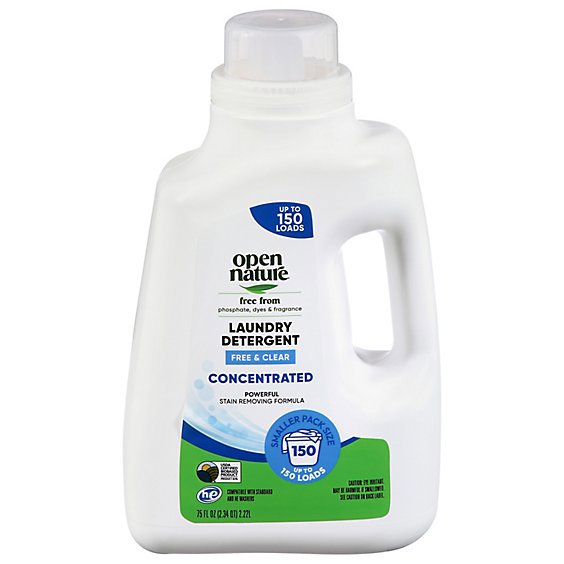
Open Nature Liquid Laundry Detergent Free & Clear
The Types at a Glance
Detergent comes in four forms, and they hold the same cleaning ingredients in different packages.
Format | What it is |
|---|---|
Liquid | Detergent suspended in water, poured from a bottle. |
Powder | Dry granules, the original form. |
Single-dose packs | A fixed dose sealed in dissolvable film. |
Sheets | A thin dry strip with the water removed. |
The type changes how you dose and store it, not what it's made of. Which one to buy is a separate question, answered in the guide to pods, powders, liquids, and sheets.
What's in the Bottle
Every detergent is built from the same few ingredient jobs. Four main ones show up on the labels.
Surfactants are the cleaning molecules and the core of any detergent. Each one has an end that grabs grease and an end that holds water, so it lifts oily soil off fabric and carries it away in the rinse.
Builders soften the water. Hard water is full of calcium and magnesium that bind up surfactants and keep them from working, so builders lock those minerals away and let the surfactants do their job. On a label they read as citrates or zeolites, sometimes carbonates.
Enzymes are targeted stain removers. They're proteins that cut specific stains into pieces small enough to rinse out. Three show up by name. Protease works on protein stains like blood, sweat, and grass. Amylase works on starches like pasta and gravy. Lipase works on grease and food oils. Enzymes are also why a modern detergent cleans in cold water, where older formulas needed heat.
Optical brighteners change how fabric looks under light without cleaning more. They're dyes that stay on the fabric, absorb invisible ultraviolet light, and give it back as a faint blue glow that makes whites look whiter. Free & Clear and sensitive-skin formulas often leave them out.
"Free & Clear"
"Free & Clear," also written "Free Clear" or "Free & Gentle," is aimed at people whose skin reacts to added fragrance and dyes. The promise is a formula made without added perfume and without added colorants, the two ingredient classes most tied to scent and skin sensitivity. The term covers fragrance and dye, nothing else in the formula.
The phrase isn't federally standardized. No regulation defines "Free & Clear," and no agency audits it. "Fragrance-free" and "unscented" aren't standardized either, and they don't mean the same thing: unscented can still contain a masking agent added to cover a base odor, while fragrance-free generally means no added scent. "Hypoallergenic" has no required testing behind it. These words point a sensitive shopper the right way, but the meaning rests on the brand, so read the ingredient list if a specific sensitivity matters.
One mark on the shelf is a real certification. The EPA Safer Choice label means the product met EPA criteria for ingredient safety and passed performance tests. A shopper who wants a vetted third-party mark rather than a self-declared phrase can look for that one.
Safeway's own store brand, Open Nature, carries Free & Clear in both liquid and packs. Arm & Hammer Sensitive Skin Free & Clear is the national-brand version on the same shelf. One reviewer of the Arm & Hammer, headed "Works well!," writes, "I have been looking for cleaner ingredients so I love that this one is Free and Clear. It works well and leaves my laundry clean just like the others."
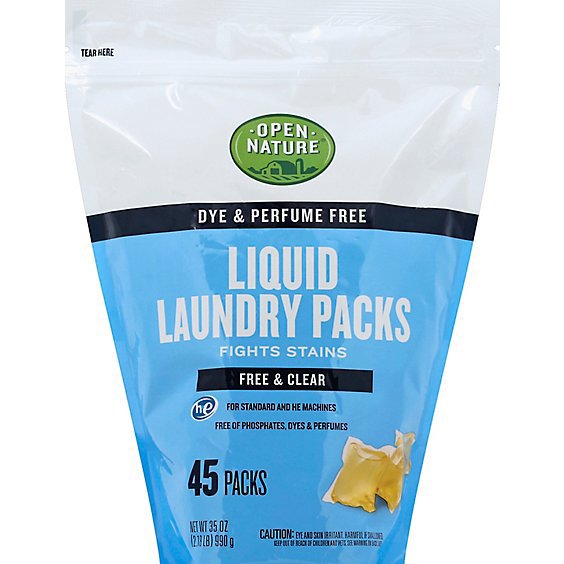
Open Nature Laundry Packs Free & Clear
The Green Words
Detergents aren't policed by a Drug Facts panel, but their environmental claims fall under the FTC Green Guides, the federal guidance on what counts as a deceptive green claim. The Guides don't ban the words. They govern how a marketer can use them, which gives a shopper a way to read them.
Claim | What it takes to say it honestly | What you can read into it |
|---|---|---|
"Eco-friendly" | The FTC warns against broad, unqualified versions, since shoppers hear a sweeping benefit the product can't back up. A green claim should say what the benefit is. | A bare "eco-friendly" tells you nothing specific. Look for the qualified version. |
"Non-toxic" | Needs proof the product is safe for both people and the environment; if it's safe for one and not the other, the claim should say which. | Not an automatic promise it's harmless to skin, to aquatic life, and if swallowed. |
"Biodegradable" | An unqualified claim shouldn't be made for anything bound for a landfill, where it won't break down in about a year. | Applies to the liquid rinsed down the drain, not the empty jug in the trash. |
"Free of [X]" | Allowed only if the substance is at trace levels at most, causes no harm at that level, and wasn't added on purpose. | "Free of dyes" is a real, checkable claim about one ingredient. It says nothing about the rest. |
"Natural" / "plant-based" | Not defined in the Green Guides and not standardized for detergent. | No fixed meaning. The word alone guarantees nothing; read the ingredients. |
A green word is only as good as its specifics. "Free of dyes" you can check. "Eco-friendly" by itself you can't.
The "HE" Symbol
A lowercase "HE" inside a circle means the detergent is built for high-efficiency washers, the front-loaders and many newer top-loaders that clean with far less water than old agitator machines. Those machines use so little water that an ordinary high-sudsing detergent would foam too much in them, so HE detergent is made to be low-sudsing and to disperse fast.
Use regular detergent in an HE machine and the excess suds cushion the clothes so they tumble less, trigger extra rinse cycles, and leave residue that builds up in the machine over time. Most detergent sold now is already HE-compatible, so a shopper with a modern washer rarely has to hunt for it. If your machine is high-efficiency, look for the "he" circle. The Tide HE liquid on this shelf carries the designation in its name.
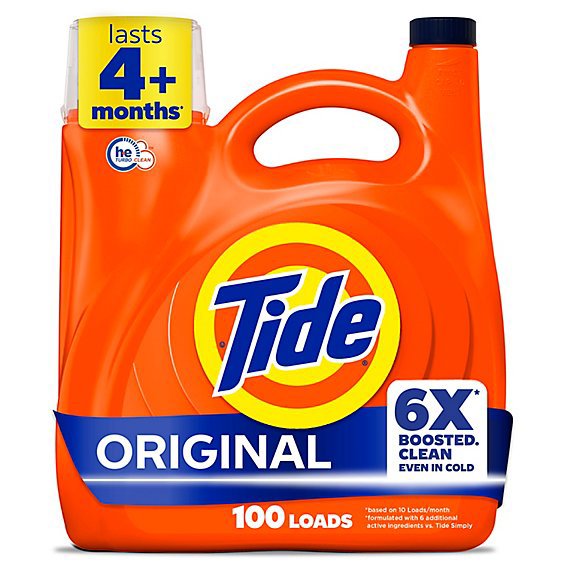
Tide HE Liquid Detergent Original
"2X," "4X," and "Concentrated"
"Concentrated," "2X," "4X," and "10X" all point at one idea: more cleaning ingredient and less water per ounce, so a smaller dose does the same job. The numbers aren't standardized, though. No rule sets what "2X" means, and the "X" is usually measured against that brand's own older formula, so one brand's "2X" and another's don't have to match. The only dose you can trust is the one printed on that package. Fill to the line for your load size rather than by eye, because the real-world error with concentrated detergent is over-pouring, which leaves residue and, in an HE machine, extra suds.
When a Detergent Claims to Kill Germs
A plain detergent cleans and makes no germ-kill claims. The moment a laundry product says it sanitizes, disinfects, or kills bacteria, the EPA treats that as a pesticidal claim, and the product has to be EPA-registered with a registration number on the label and efficacy data behind it. A "kills 99.9% of bacteria" line is the manufacturer's EPA-registered claim, so look for the EPA Reg. No. on the label and read the claim as the maker's, not as something you can assume.
Scent Boosters
The small bottles of in-wash scent beads are a fragrance add-on, with little or no cleaning surfactant. They make laundry smell stronger for longer and go in the drum alongside detergent. If a label sells scent instead of cleaning, it's a booster to use with detergent, not one that replaces it.
Buying It at Safeway
At the shelf, look at three things on the box. The format sets how you dose and store it. Among the claim words, "free of dyes" and the EPA Safer Choice mark are checkable, while "eco-friendly" and "natural" are not. And the "he" circle tells you it fits a high-efficiency machine.
Safeway's own Open Nature line covers the sensitive end of the shelf, with Free & Clear in liquid and packs and a lavender-scented version for anyone who wants fragrance. One shopper of the Open Nature Free & Clear packs, headed "Laundry soap to feel ok using," writes they're "easy to use at work and at home, without added unnecessary chemicals." Tide and Arm & Hammer are the national brands alongside it. Availability and scents vary by store, so check your Safeway's shelf or the app.
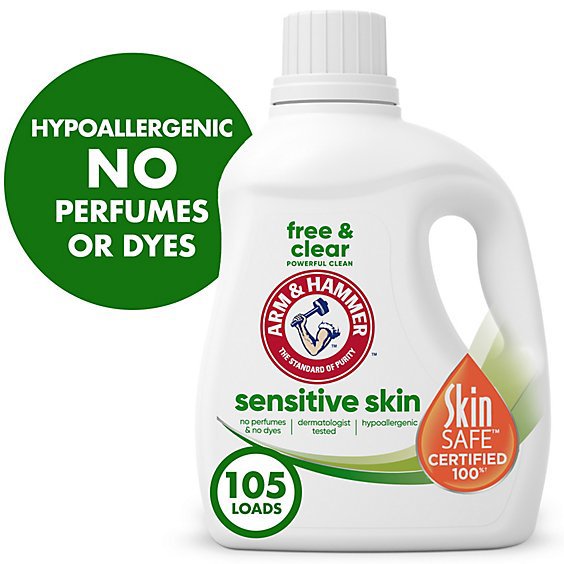
ARM & HAMMER Sensitive Skin Free & Clear
Common Questions
What are the main types of laundry detergent?
Four: liquid, powder, single-dose packs, and sheets. They hold the same kinds of cleaning ingredients in different packages, and they differ mainly in how you dose and store them. Which one fits your laundry is covered in the guide to pods, powders, liquids, and sheets.
Does "Free & Clear" mean the detergent is fragrance-free?
It means made without added fragrance and added dyes, which is what most people want from it. But the phrase isn't federally standardized, and neither is "fragrance-free" or "unscented," so the meaning rests on the brand. If you react to a specific ingredient, read the list rather than trusting the front of the box. Open Nature and Arm & Hammer both carry Free & Clear versions.
What does "he" on a detergent label mean?
It marks the detergent as low-sudsing for high-efficiency washers, the front-loaders and newer top-loaders that use less water. Regular detergent in an HE machine foams too much and can leave residue over time. Most detergent sold today is already HE-compatible, so look for the "he" circle only if your machine is high-efficiency.
Is "eco-friendly" or "natural" detergent better for the environment?
The words alone don't tell you. Under the FTC Green Guides, broad claims like "eco-friendly" and "natural" carry no fixed meaning and read as marketing, while specific ones like "free of dyes" or "readily biodegradable" can be checked. For a vetted mark, look for EPA Safer Choice, which requires both ingredient-safety criteria and a performance test.
What are the enzymes in laundry detergent for?
They break down specific stains into pieces small enough to rinse away. Protease handles protein stains like blood, sweat, and grass. Amylase handles starches like pasta and gravy. Lipase handles grease and food oils. Enzymes also let a detergent clean in cold water, where older formulas needed heat.
What does "2X" or "concentrated" mean on detergent?
More cleaning ingredient and less water per ounce, so a smaller dose does the same job. The number isn't standardized, though, and usually compares the detergent to the brand's own older formula, so a "2X" from one brand isn't the same strength as another's. Follow the dose line on that package, and take care not to over-pour, which is the common mistake with concentrated formulas.