Bestsellers for Baking Soda & Powder


Baking soda and baking powder are found side by side on grocery shelves, and both look like simple white powders in small containers. Both are chemical leaveners that make carbon dioxide through acid-base reactions rather than the fermentation yeast relies on. While yeast depends on living cells that slowly consume sugars over hours to produce gas, chemical leaveners work through direct chemistry, producing gas bubbles that expand inside batter or dough to create a light crumb in minutes.
Baking soda is sodium bicarbonate, and requires an acidic ingredient to make baked goods rise. Baking powder contains sodium bicarbonate, dry acids, and cornstarch, so moisture and heat are all that’s needed to activate it.
They are not interchangeable. Baking soda has roughly three to four times the rising power of baking powder. To replace 1 teaspoon of baking powder, use 1/4 teaspoon of baking soda with 1/2 teaspoon of cream of tartar. Replacing baking soda takes about three times as much baking powder, though the finished taste and texture may change.
Baking Soda and Baking Powder Are Made Differently
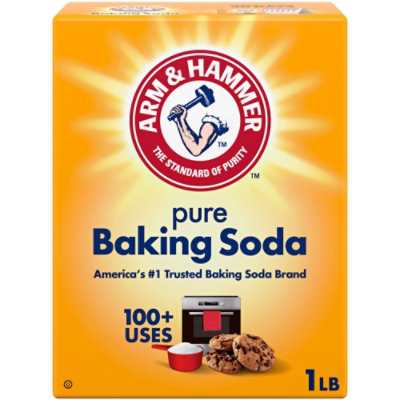
Baking soda has one ingredient, sodium bicarbonate, and because it is a base, it needs to interact with both an acid and moisture before it can release the carbon dioxide bubbles that expand batter or dough. The Arm & Hammer box lists only sodium bicarbonate. Signature SELECT, Safeway's own brand, prints the same single ingredient on its baking soda box. It is a pure compound, without blended starches or additives.
Much of the sodium bicarbonate sold in the US is made from soda ash that comes from trona, a mineral mined in southwestern Wyoming. Refined to food-grade purity, it provides reliable leavening across commercial and home kitchens. The Food and Drug Administration (FDA) lists sodium bicarbonate as “Generally Recognized as Safe (GRAS)” for food use under 21 CFR 184.1736.
When dissolved sodium bicarbonate meets an acid, it forms carbonic acid, which breaks down into water and carbon dioxide gas. The water blends into the batter, while the carbon dioxide gas forms thousands of tiny bubbles that lift the dough in the oven.
Bob's Red Mill boxes the same single ingredient, and Arm & Hammer also sells it in a 4 lb box.

Ingredients Sodium Bicarbonate
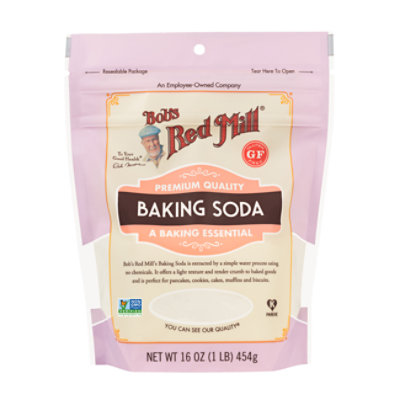
Ingredients Sodium Bicarbonate.
Baking powder combines the base and dry acids in one can, with cornstarch used to absorb moisture. The ingredient lists on Signature SELECT and Clabber Girl powders are identical, listing cornstarch, sodium bicarbonate, sodium aluminum sulfate, and monocalcium phosphate. Cornstarch acts as a dry buffer, keeping ambient humidity from triggering the acid salts and sodium bicarbonate while the can sits on your shelf.
When the base and an acid react, they produce carbon dioxide. University of Illinois Extension compares this bubbling to the reaction in a school volcano experiment. In batter, these gas bubbles provide the rise, and in cake batter, that same fizzing action is trapped within flour proteins and starches, creating tender pockets that keep your bake soft.

Use the Leavener the Recipe Calls For
Use baking soda when the recipe contains enough acid to activate it. North Dakota State University Extension and Arm & Hammer give examples, such as brown sugar, molasses, honey, buttermilk, yogurt, sour cream, chocolate, and cocoa. Buttermilk, sour cream, and yogurt contain lactic acid, which reacts with sodium bicarbonate to release gas while mellowing the soda's alkaline edge.
Chocolate ingredients differ. Natural cocoa powder is acidic, with a pH around 5.5, which activates baking soda without difficulty. Dutch-processed cocoa behaves differently. The Exploratorium explains that Dutch-processed cocoa is treated with an alkaline solution that raises its pH to 7 or 8, so a recipe that uses it with baking soda needs another acidic ingredient, or should use baking powder instead.
The reaction starts as soon as the soda, acid, and moisture meet, so K-State Extension advises using the batter promptly and mixing it lightly. This is because waiting too long or vigorous mixing lets carbon dioxide bubbles escape or break before baking. A heavy hand with the whisk or letting the batter sit on the counter allows those delicate gas pockets to pop. Fold the ingredients gently just until combined, then bake right away.
Baking powder belongs in recipes that do not supply another acid because its acid salts are already present, so adding liquid starts the reaction. Standard yellow cakes, sugar cookies, and biscuits rely on sweet milk, white sugar, and butter, none of which supply acid. Baking powder brings its own acid salts, needing only the liquid in the recipe to start releasing gas.
A recipe may call for both when its acidic ingredients cannot produce enough gas with soda alone, while the soda also affects browning, flavor, and color in cookies and muffins. Baking soda speeds browning because an alkaline dough browns faster, which is why a little soda helps cookies spread and turn golden.

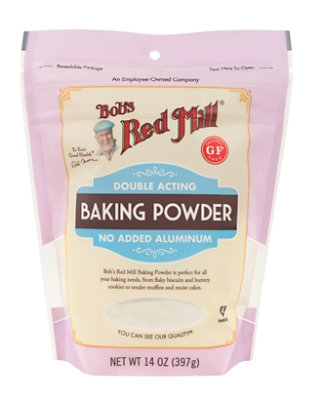
Bob's Red Mill is another double-acting powder on the shelf. Read its acid salts the same way.
A wrong amount can change the result. Soda left without enough acid can remain unreacted and give cookies or cake a bitter, soapy, or metallic taste. Using powder in place of soda will usually give less rise and a denser texture, Arm & Hammer notes. Excess soda that never meets an acid breaks down in the oven heat into sodium carbonate, which tastes soapy and can give light cakes a yellowish color.
Double-Acting Powder Rises in the Bowl and Oven
Double-acting baking powder releases carbon dioxide twice. Moisture starts the first reaction in the bowl, then heat starts another reaction during baking. This two-phase release gives bakers flexibility. If you need to bake cookies in consecutive batches, the batter will still rise well in the oven.
Virginia Cooperative Extension identifies monocalcium phosphate as the acid that reacts when moistened and sodium aluminum sulfate as the one that reacts with heat. These are the two acid salts on the Signature SELECT and Clabber Girl labels. Monocalcium phosphate dissolves immediately in cold liquid, producing an initial burst of gas in the bowl. Later, the rising oven temperature activates the sodium aluminum sulfate, triggering a second surge of carbon dioxide as the crumb sets.
Single-acting powder exists, but it reacts once and must go into the oven quickly. Because it contains only a fast-acting acid that reacts upon contact with liquid, any delay allows the gas to escape.
Rumford is also double-acting, but its label lists calcium acid pyrophosphate and monocalcium phosphate, with no aluminum salt printed among the ingredients.
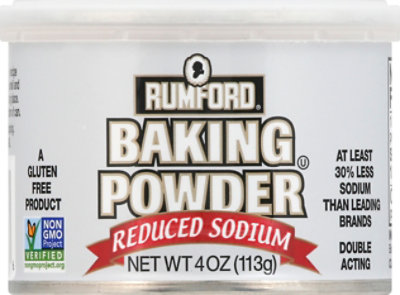
The description of “aluminum-free” indicates that the powder omits sodium aluminum sulfate and uses an acid such as calcium acid pyrophosphate or sodium acid pyrophosphate instead. These phosphate compounds provide the heat-triggered rise without using aluminum salts. Some bakers say aluminum-based powders leave a faint metallic taste, most noticeable in delicate bakes like biscuits or scones. Choosing an aluminum-free brand eliminates that metallic note while maintaining a double-acting rise.
How to Substitute Baking Soda and Baking Powder
Running out of leavener does not have to stop your baking. You can substitute one for the other if you balance the acidity and leavening strength. Baking soda is about three to four times as strong as baking powder, so equal spoonfuls do not work.
Using equal measurements will spoil your bake. Replacing baking powder with an equal spoonful of baking soda leaves unreacted base in the batter, creating a harsh flavor and an off-color crumb.
Illinois Extension, K-State Extension, Arm & Hammer, and Clabber Girl give the same basic conversion:
If the recipe calls for | Use instead |
|---|---|
1 teaspoon baking powder | 1/4 teaspoon baking soda plus 1/2 teaspoon cream of tartar |
1 teaspoon baking powder | 1/4 teaspoon baking soda plus 1/2 cup buttermilk, sour milk, or yogurt; decrease the liquid in the recipe by half |
1 teaspoon baking powder | 1/4 teaspoon baking soda plus 1 teaspoon lemon juice or vinegar; the taste may change |
1 teaspoon baking soda | About 3 teaspoons baking powder; the taste and texture may change |
Cream of tartar supplies the acid when you make the direct powder substitute. Because it is a dry powder, it blends cleanly with your flour without altering the moisture ratio of the batter. The Signature SELECT product page also says it can be beaten with egg whites to create stable, stiff peaks for angel food cakes, meringue cookies, and frostings.

Cream of tartar is potassium bitartrate, an acid salt left behind when grape juice ferments into wine. When purified and ground, this potassium bitartrate provides the acid that reacts with the sodium bicarbonate. When you combine 1/4 teaspoon of baking soda with 1/2 teaspoon of cream of tartar, you recreate the essential chemistry of commercial baking powder.
Scaling the swap is simple. If a recipe calls for 2 teaspoons of baking powder, use 1/2 teaspoon of baking soda and 1 teaspoon of cream of tartar. If it calls for 1/2 teaspoon of baking powder, use 1/8 teaspoon of baking soda and 1/4 teaspoon of cream of tartar.
Liquid substitutes work when cream of tartar is not available. Combining 1/4 teaspoon of baking soda with 1/2 cup of buttermilk, sour milk, or yogurt replaces 1 teaspoon of baking powder. You should therefore decrease the recipe's other liquids by half a cup to maintain consistency. If a recipe calls for 1 cup of milk, cut that milk back to 1/2 cup and stir in 1/2 cup of buttermilk. You can also mix 1/4 teaspoon of baking soda with 1 teaspoon of lemon juice or vinegar, though the taste may change.
Replacing baking soda takes about 3 teaspoons of baking powder for every 1 teaspoon of soda. Baking powder contains cornstarch and acid salts alongside sodium bicarbonate, so you need three times as much to match the rising power. That extra volume can slightly alter the final texture and taste.
Baking at a high altitude requires less leavener. Colorado State University Extension says leavening gases expand more quickly where air pressure is lower, which can make cakes rise too fast and collapse. At lower air pressures, gas bubbles balloon rapidly before the cake's structure sets, stretching cell walls until they burst.
For elevations of about 3,500 to 6,500 feet, its guide suggests reducing baking powder by 1/8 teaspoon per teaspoon in the recipe, and by more at higher elevations. If a recipe calls for 2 teaspoons of baking powder, reduce it by 1/4 teaspoon and use 1 3/4 teaspoons instead to prevent collapsed centers.
Test an Open Container Before You Bake
Neither baking soda nor baking powder spoils in a way that causes illness, but both lose their leavening power over time. Humidity causes them to react slowly in storage, so testing an open container ensures your batter will rise.
Test baking soda with vinegar by putting 1 1/2 teaspoons of soda in a small bowl and adding 1 tablespoon of vinegar, as directed by Penn State Extension. Fizzing means it can still leaven. If the mixture shows only faint fizzing or settles to the bottom, the soda has lost its rising power. Water alone cannot test soda because soda does not carry the acid needed for the reaction.
For baking powder, mix 1 teaspoon with 1/3 cup hot water. Vigorous foam means it still has rising power. Plain water works here because powder contains its own acid, which dissolves alongside the base to foam immediately. If the water remains flat or bubbles weakly, discard the can.
Keep both products closed in a cool, dry place away from the stove, and dip into the container only with a dry spoon. Cabinets near the stove expose containers to steam, and a damp spoon introduces moisture that triggers reactions right inside the container.
The USDA FoodKeeper guide lists 6 months in the pantry after opening for baking soda and 3 to 6 months for baking powder. Rumford's label says to use its powder by the best-buy date or 6 months after opening. Writing the opening date on the lid helps you track freshness.
K-State says an open box in the refrigerator absorbs odors as it deodorizes. It can take on those smells, so keep a separate box for baking. Sodium bicarbonate pulls food odors out of refrigerator air. Scooping from that same box can transfer trapped refrigerator aromas into your cookies and cakes. Keep an open box in the fridge for odors and a tightly sealed container in the pantry for baking.
Common Questions About Baking Soda and Baking Powder
Can I use baking soda instead of baking powder?
Yes, if you add acid and change the amount. Use 1/4 teaspoon baking soda plus 1/2 teaspoon cream of tartar for every 1 teaspoon of baking powder the recipe calls for. Without that added acid, the soda may not create enough carbon dioxide and can leave a soapy or metallic taste.
Is baking soda the same as baking powder?
No. Baking soda is sodium bicarbonate, while baking powder combines sodium bicarbonate with dry acids and cornstarch. Baking soda needs an added acid and moisture to react, while baking powder only needs moisture and heat.
What does double acting mean?
Double-acting baking powder releases some gas when moisture reaches it in the bowl, and releases more when the batter or dough is heated in the oven.
How do you test if baking powder is still good?
Mix 1 teaspoon of baking powder with 1/3 cup hot water. Vigorous foam shows that it still has rising power.
Why does my baking taste metallic or soapy?
The recipe likely uses more baking soda than its acid can neutralize. The unreacted soda can leave a bitter, metallic, or soapy taste. Heat turns unreacted sodium bicarbonate into sodium carbonate, which tastes bitter and soapy.
Does baking soda go bad?
Baking soda loses its power over time rather than spoiling like a perishable food. FoodKeeper lists 6 months after opening as a pantry guideline. To check an older box, add 1 tablespoon of vinegar to 1 1/2 teaspoons of soda. If it fizzes, it can still be used.
What does aluminum-free mean on baking powder?
Aluminum-free baking powder contains no sodium aluminum sulfate. It uses acids such as calcium acid pyrophosphate or sodium acid pyrophosphate alongside monocalcium phosphate and is still double-acting. Some bakers say aluminum-based powders leave a faint metallic taste.
Why do chocolate and molasses recipes call for baking soda?
Cocoa and molasses are naturally acidic ingredients that activate baking soda. Natural cocoa powder has a pH around 5.5, according to the Exploratorium, and molasses carries organic acids. Baking soda neutralizes these acids and produces carbon dioxide.
How do I adjust leaveners for high altitude?
At elevations above 3,000 feet, lower air pressure makes leavening gases expand more quickly, according to Colorado State University Extension. Its guide suggests reducing baking powder by about 1/8 teaspoon per teaspoon at roughly 3,500 to 6,500 feet and by more at higher elevations, so cakes do not collapse.